
 Contact Us


At the heart of the region
The decision to create a spaceport in French Guiana in 1964 linked the history of CNES, the site’s owner and co-manager, to that of French Guiana itself. Since then, the space sector has been an integral part of the region, and CNES has become an active partner in French Guiana’s social, cultural and economic life.
A major economic player
The space sector accounts for just over 12% of French Guiana’s GDP. According to the 2019 INSEE survey, nearly 4,500 jobs are linked to the space sector, representing one in six in the private sector. Today, companies at the spaceport employ 1,600 permanent staff, 80% of whom are local residents. The sector accounts for 36% of investment in the region and 13% of tax revenue (INSEE 2019).
A tourist attraction
The spaceport’s tourist attractions (launches, tours of the facilities and savannah areas, Guyaspace Expérience) draw around 50,000 people a year, a large proportion of whom are visitors from outside the region.
As the space sector’s momentum has a knock-on effect on the economy as a whole, its current opening up to new players in the sector is helping to further boost the region’s profile and appeal.
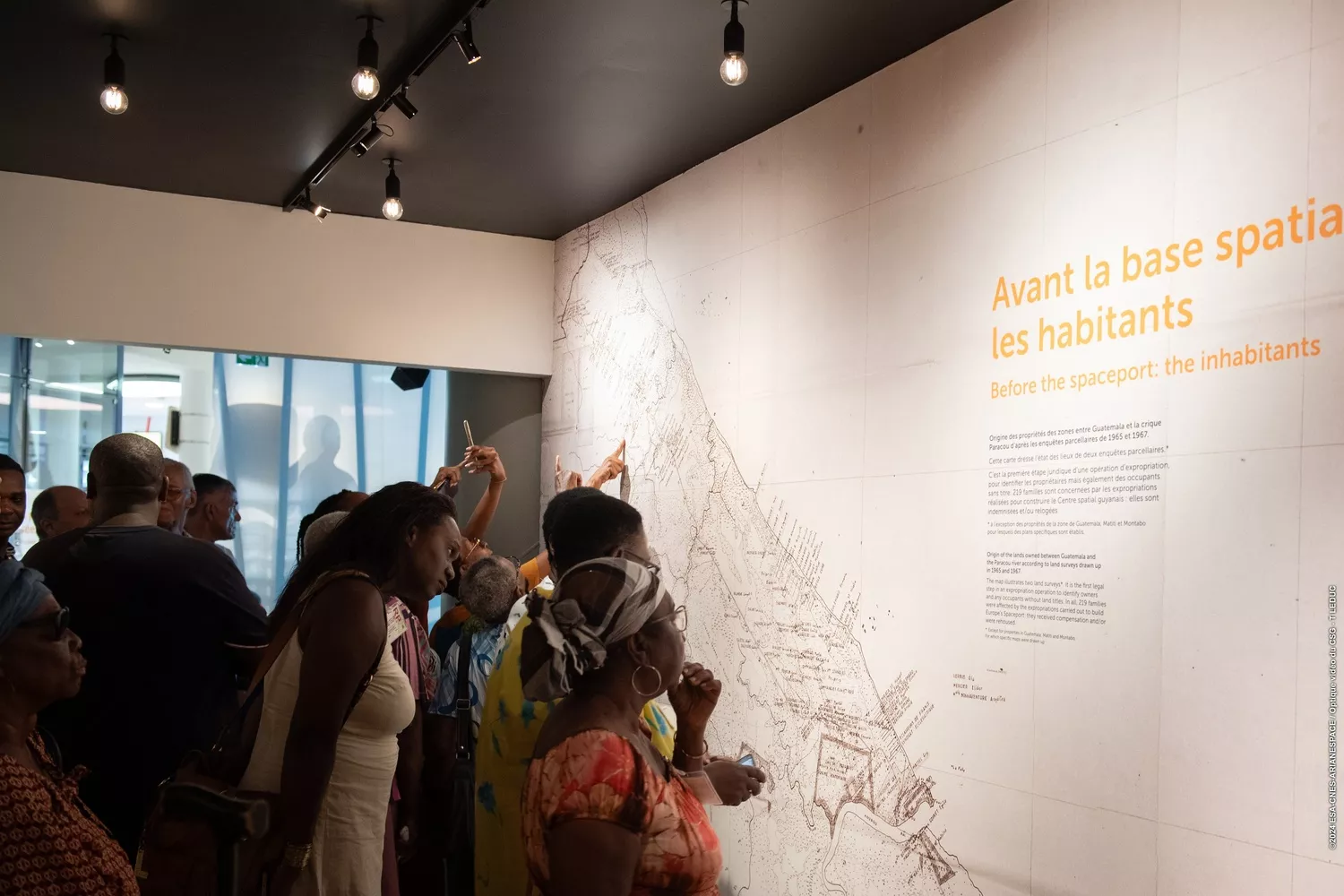
The testimonies of those who were expropriated and of their families mark the start of the tour at Guyaspace Expérience. A behind-the-scenes look at the spaceport, which offers an unflinching account of the development of the space sector in French Guiana
A shared history and heritage
The shared history between CNES and French Guiana that has been unfolding for over 60 years is also a human story. CNES is committed not only to keeping the memory alive, but also to enriching the region’s legacy on a daily basis, together with the people of French Guiana.
At Guyaspace Expérience, a museum exhibition developed together with associations representing the families displaced from Kourou and Sinnamary tells the story of the removal and rehousing of 219 families. Today, CNES continues to support these families by contributing, for example, to the renovation of the Cité du Stade in Kourou, where some of those whose land was expropriated now live, and the upgrading of the Mélanie Road, which provides access to agricultural plots.
On the Îles du Salut [Salvation Islands], CNES strives to maintain and promote the natural and historical heritage. The aim is to protect these fragile areas, to guarantee the supply of water and electricity, and to ensure safe access to the beaches and forests, as well as to places of historical significance: the ruins and museum of the penal colony, the hospital and chapel on Île Royale. Though CNES owns the islands, it does not own all the buildings and does not act alone. The development plans are discussed with the various partners: the French government, the towns of Cayenne and Kourou, the CACL (the inter-communal authority covering Cayenne, Macouria, Matoury, Montsinéry-Tonnégrande, Rémire-Montjoly and Roura) and the Conservatoire du littoral.
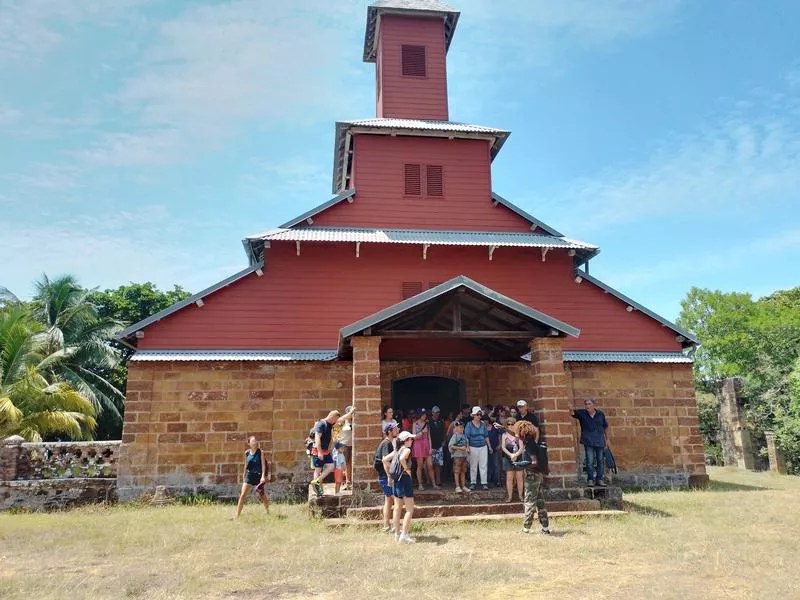
The built heritage of the Îles du Salut (shown here: the chapel on Île Royale) is listed in the register of historic monuments. CNES is a founding member of the Agamis association, which manages them.
12 %
The space sector accounts for just over 12% of French Guiana’s GDP
1.24
Every job in the spaceport generates 1.24 jobs in the rest of the French Guiana economy
50,000
The spaceport’s tourist attractions draw 50,000 visitors a year